
Lazerlamps About & FAQ

LAZER LAMPS - high performance lighting
Since its founding in 2010, the British manufacturer Lazer Lamps Ltd. has been at the forefront of LED technology, providing its customers with world-class technology and setting the standard for automotive auxiliary lighting solutions. By combining superior performance with automotive quality standards, Lazer products are now recognized as leaders in their field.
Lazer is proud to manufacture products in the UK and has introduced market-leading products driven by company director Ben Russell-Smith, who has been at the forefront of vehicle lighting design since 2002, leading exterior lighting projects at Nissan's European Technical Centre and Ford of Europe.
SUPERIOR DESIGN AND CONSTRUCTION QUALITY
Our UK facility handles all aspects of design, engineering, and product assembly, including final leak testing and photometric testing in accordance with UNECE production conformity requirements. Crucially, surface mounting of components onto the printed circuit boards is performed at a secondary site just 30 minutes away, ensuring complete traceability and control of the entire manufacturing process. With both facilities ISO 9001 certified and centrally located in a hub of high-tech companies spanning the automotive, defense, and aerospace industries, this helps keep Lazer and our supply chain at the forefront of new technologies and manufacturing methods that guarantee the performance, quality, and reliability of our products.
PRODUCTS YOU CAN TRUST
Race Tech Awards 2012
From the outset, the motorsport market quickly embraced Lazer products, with some of the biggest names in racing switching on their lights early on. In its first year of production, Lazer products were nominated for three awards in international motorsport, including "Most Innovative New Motorsport Product 2012".
Since then, more and more teams and drivers, for whom there can be no compromise on performance and reliability, have made the switch to Lazer. The clearest example of this is our high-profile partnerships with leading teams in both the WRC (M-Sport) and the World Endurance (Toyota Motorsport) series. However, our success isn't limited to the world of motorsport, as Lazer lighting solutions are widely used by the protagonists of grueling off-road events like the Dakar Rally and King of the Hammers, a testament to the build quality and robustness of every product that leaves our facility.
Success on the racetrack has helped lend credibility to the brand, which translates into trust for the road buyer who chooses to install the same products in their vehicles. Having recognized the suitability of our products for the 4x4, pickup, and commercial vehicle sectors, we are now approved suppliers to OE manufacturers in each of these sectors. However, we won't rest on our laurels, and the development of new lighting products continues, driven by technological advancements and innovation. Innovation isn't limited to our lighting solutions, though; we're increasingly focused on how our products integrate with different vehicles, meaning Lazer is becoming known for both its mounting solutions and its superior lighting. With continuous product development as a priority and an expanding global distribution network, Lazer Lamps is a company with big plans for the future, so keep an eye on this area!
BUYER'S GUIDE - ECE REGULATIONS AND THEIR COMPLIANCE
If you are fitting your vehicle with auxiliary headlights, there are a few things you need to know:
It's easy to install auxiliary headlights and comply with regulations in all countries worldwide. Installing auxiliary headlights can increase safety and improve nighttime visibility for the driver.
It is the driver's responsibility to ensure that the vehicle complies with the regulations of the respective country.
CHOOSING THE RIGHT LIGHT
Aside from their function as a cut-off switch, most people installing auxiliary headlights don't want a separate switch on the dashboard; they simply want the headlights to switch on with the vehicle's existing high beams and off when the driver dips the headlights. In most countries, this is possible if the auxiliary headlights are "approved" or "manufactured." If non-approved headlights are used on the vehicle, they should, in most countries, either be covered or at least switched on separately from the main headlights when driving on public roads.
WHAT IS AN "APPROVED HEADLIGHT"?
In all European countries, as well as in several others (Japan, Australia, etc.), it is mandatory that all auxiliary lighting be "approved headlights." Automotive headlights are approved according to UNECE Regulation 112 or 113, which involves comprehensive product testing, including tests such as lens scratch resistance, on/off functionality, thermal resistance, and more. If the headlight passes these tests, it is certified, and the manufacturer is authorized to affix an E-mark to the lens. The E-mark is a printed or embossed letter E, surrounded by a border and accompanied by a number indicating where the approval tests were conducted. All current Lazer products have been approved in Spain and therefore bear an E9 symbol, where the 9 indicates Spanish testing. This country code is only an indication of the testing location; once approval is granted, it is valid in any country that has adopted the E-mark system. With the UK's withdrawal from the EU, we have already received confirmation that the E9 approval of our lamps is not affected by Brexit. Click here for a full list of signatories to this system.
REFERENCE MARK
Every approved headlight is assigned a "reference mark" that relates to the maximum peak intensity of the light emitted by the unit at a distance of 25 meters. Some countries require that the maximum permissible reference mark for road use be 100. Therefore, if the vehicle's standard headlights have a reference mark of 20, the driver should only be able to install four additional headlights, each of which can have a reference mark of 15. Lazer products diffuse or focus the light differently, but the relatively low peak intensity rating of many of our headlights is achieved by distributing the vast amount of light produced by these products over a large area in a homogeneous and smooth light pattern, or, in the case of Triple-R products, by a greater difference between the two output functions, which allows these products to achieve certification.
ASSEMBLY LOCATION
Positioning headlights high can be a real advantage when it comes to reducing shadows cast by uneven road surfaces, which occur when the driver's eye level is below the beam. In Europe, headlights must not be mounted higher than 4 meters. If a light with an integrated position light function is used (approved according to UNECE Regulation 7), more specific installation requirements apply. Please consult our installation instructions sheet for permissible mounting locations. There may also be regional regulations requiring the deactivation of the vehicle's standard position lights when additional position lights are used.
COUNTRY-SPECIFIC VARIATIONS
Thirty-eight countries worldwide have adopted the UNECE regulations, but enforcement varies. Most countries require auxiliary headlights to be fitted in pairs, but some, including the UK, Norway, and Sweden, allow the installation of a single (or odd number) lamp. There are also regional differences to consider, such as the strictness with which the reference marking is enforced, the requirement in Australasia to always have a separate isolator switch, or the requirement in Switzerland to cover the lamps when not in use. If you are unsure, or even think you are, we always recommend speaking to an expert who knows and understands the regulations in each country. Our Dealer Locator is a great starting point for finding people who are familiar with the regulations in your area.
SUMMARY
Purchasing an "approved headlight" provides assurance that the product has been correctly developed and can withstand a rigorous and demanding testing program. It offers the driver the added benefit of being able to wire the units directly to the headlights for high beams, eliminating the need for a separate switch on the dashboard, which often increases installation time and reduces ease of use.
BUYING ADVICE - BEAM SAMPLES
.jpg)
LED technology is evolving rapidly, becoming not only more efficient but also more reliable. As a market leader and innovator, we are constantly striving to improve our existing products and launch new ones, optimizing light output for various applications based on light intensity, roadside visibility, and upward/downward beam spread. Considering our diverse product range, including new and updated products available since this fall (including our Linear and Triple-R Elite 3 series), we examine the differences in light distribution and when and where some products might perform better than others.
TRIPLE-R
Example: TRIPLE-R 1000
Peak value: 368k cd
Horizon: 11 degrees dispersion
Vertical: 14-degree dispersion
(2% of the peak)
The Triple-R Standard range offers excellent long-range visibility in a spot beam pattern with a comfortable left/right spread of light in the mid-range. What you don't get is much light close to the vehicle at the edges of the road. The Standard range is also designed to offer a wider vertical spread compared to the equivalent Elite or Linear products. This isn't as much of an issue when mounting lights at license plate height, but it's true that proportionally more light hits the road relatively close to the vehicle. For this reason, the Triple-R Standard is particularly well-suited for higher mounting positions, such as roof bars or the upper grille.
Triple-R Elite
Example: Triple-R 1000 ELITE-3
Peak value: 456k cd
Horizon: 21 degrees dispersion
Vertical: 9 degree dispersion
(2% of the peak)
The launch of our 3rd generation Triple-R Elite was eagerly anticipated for good reason, and the light output is so good that we can confidently call these our ultimate road-legal driving lights. Higher power/intensity LEDs compared to the equivalent standard products, coupled with a modified reflector system, provide even greater long-range illumination with improved roadside visibility – 2% of the peak line at 21 degrees spread versus 11 degrees for the equivalent standard product. The improved roadside illumination is partly achieved through reduced upward/downward light scatter, meaning the Triple-R Elite can be safely mounted low to the ground without worrying about a bright spot on the road directly in front of the vehicle. The Triple-R Elite (Gen3) largely utilizes the same internal electronic and optical systems as our Carbon series lights, making it an excellent choice for motorsport.
ST-EVOLUTION
Example: ST8 EVO
Peak value: 154k cd
Horizon: 28 degrees dispersion
Vertical: 24-degree dispersion
(2% of the peak)
Ask anyone who has driven with the ST/T Evolution lights, and they will tell you that the "Driving" beam pattern, which provides a symmetrical left/right and up/down distribution of light, coupled with a light intensity far exceeding that of a standard vehicle high beam, is exceptionally comfortable for everyday road use. Excellent light distribution over the short and mid-range also works wonders on any 4x4 or off-road excursion. However, improved all-around visibility means you will sacrifice some long-range illumination compared to the Triple-R lights. So, consider the type of roads or terrain you will be driving on to decide whether greater distance or better spread is preferable. The ST/T Evolution lights' higher vertical beam pattern inevitably means they are better suited to slightly higher mounting positions, and consider whether glare might be an issue if they are mounted on the roof above the hood of a car.
LINEAR STANDARD
Example: LINEAR-12
Peak value: 122k cd
Horizon: 34 degrees spread
Vertical: 11-degree dispersion
(2% of the peak)
The Linear range was developed in part based on feedback from road users who wanted less up/down light spread and better visibility at the edges of the road compared to our Triple-R Standard and ST Evolution lights. With the Linear Standard, you have access to a cost-effective range of high-performance high beams that offer a higher level of illumination with better range and left/right visibility compared to standard high beams, even though they still have half the total light output you would expect from the equivalent Linear Elite, Triple-R, or ST product. The up/down spread is also narrower than that of the Linear Elite or Triple-R Elite, delivering proportionally less light on the road directly in front of the vehicle, even when mounted very low, for example, through lower grille openings.
LINEAR ELITE
Example: LINEAR-12 ELITE
Peak value: 158k cd
Horizon: 42 degrees dispersion
Vertical: 15-degree dispersion
(2% of the peak)
If space is limited or you want a flat, slim solution with light output comparable to the larger ST or Triple-R products, then the Linear Elite is perfect for you. For a product of its size, its light output is exceptional and similar to the Triple-R Elite in terms of beam pattern, increased light intensity for improved long-range visibility, and the provision of very good side illumination.
THE PERFECT ROOF INSTALLATION
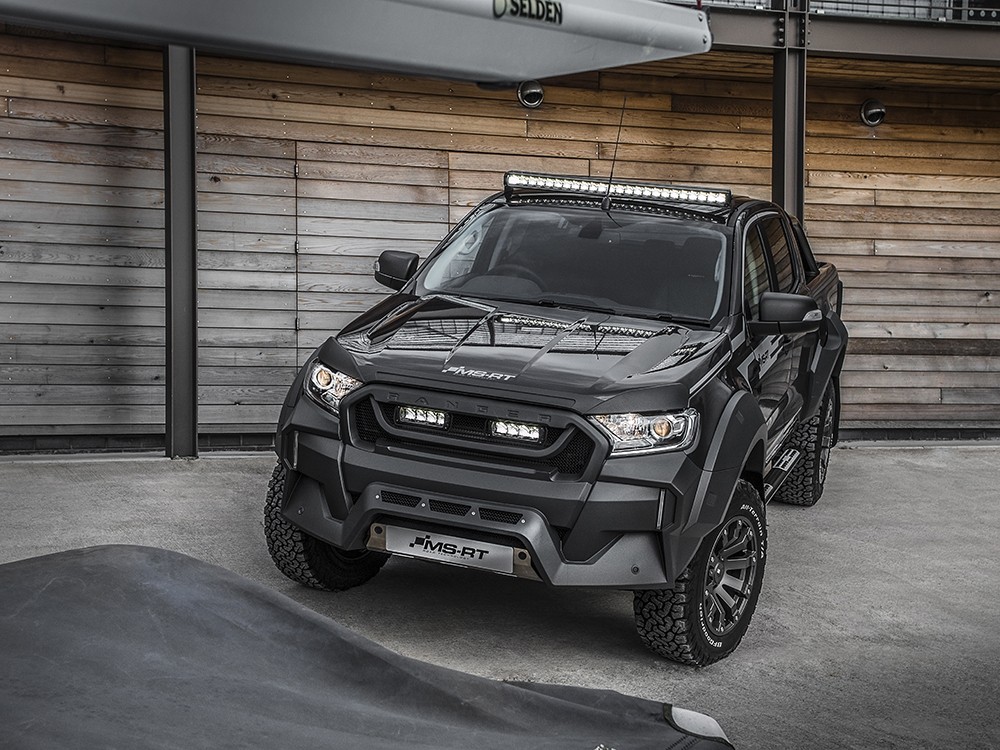
Following the launch of our Linear 36, 42, and 48 rooflights, along with our range of universal roof mounting kits, now is a great time to analyze your potential rooflight installation and provide a brief guide to selecting the right light and mounting solution for you and your vehicle. We understand that a rooflight is a significant investment, so it's important that you feel confident about how the final solution will look and perform. In this guide, we'll walk you through the process of deciding which Lazer rooflight best suits your needs, as well as where and how to position your light for the perfect installation.
Available space
You can immediately narrow down your choice of lights by considering the size of your roof and the available mounting space. Mounting from a roof rack or similar allows for a high degree of flexibility in fitting lights of varying lengths, typically using just one pair of our stainless steel side brackets. If not, consider the spacing between your roof rails or roof gutters, then check the dimensions below (full dimensioning diagrams are available on the relevant product pages). Don't be concerned if the light is up to 65mm short at both ends, as the anti-theft/spacer kits included with our brackets allow you to compensate for the gap on either side.
Linear-36 (982mm/39"); Linear-42 (1132mm/45"); Linear-48 (1282mm/50")
Triple-R 16 (765mm/30"); Triple-R 24 (1125mm/44"); Triple-R 28 (1305mm/51")
T-16 Evolution (684mm/27"); T-24 Evolution (1004mm/40"); T-28 Evolution (1164mm/46")
Lighting options
Which Lazer rooflight is best for you, considering the light output, features, and benefits of each product type? Below is a brief summary of how our lights differ and what you can expect from each one.
Linear:
Sleek, streamlined, and aerodynamic, our Linear series offers a discreet, stylish installation with a light output that belies its diminutive size. The light distribution is tailored for everyday road use, with less upward/downward scatter and proportionally more left/right scatter, yet still providing an intensity that leaves little to the imagination. With the added benefit of ECE road approval (at the upper end of the permissible road approval limits), both the Linear-36 and Linear-42 can be wired directly into your vehicle's high beam circuit without the need for a separate switch. Very low glare on the hood, coupled with exceptionally low wind noise, further enhances the appeal of roof-mounted Linear lights.
Triple-R:
If you're looking for ultimate long-range visibility with light output that meets the highest demands of professional motorsports, then Lazer's Triple-R series is exactly what your vehicle needs. Specifically tuned for a focused beam pattern, the Triple-R series still achieves good mid- to long-range coverage. It's well-suited for long stretches of dark road where anything can happen and you need to stay ahead. The high-end design and styling of the Triple-R products ensure they turn heads day and night, although their larger proportions compared to Linear or T-Evolution make them a solution for those who want their roof lights to be noticed!
T-Evolution:
With its fantastic all-around light distribution, the T-Evolution range is a great choice, especially for off-road use where long-range illumination isn't necessarily as important as exceptional short- and mid-range visibility up/down and left/right. The updated, contemporary design of the T Evolution range since 2018, featuring a seamless polycarbonate lens, means these lights will look great on your vehicle. However, consider the placement of the light on the roof carefully – the higher vertical angle of the light distribution can cause glare from the hood or light loss on the roof of your vehicle, which is something you should consider first.
Roof brackets
You've chosen your light; now it's time to select the right mounting solution. Aside from custom-designed brackets for vehicles like the Ford Ranger and Land Rover Defender, our universal mounting kits are divided into two categories: brackets for use with roof rails and brackets for vehicles without roof rails. Each bracket type is available in different heights to suit specific requirements.
- the position of the brackets/lamp on the roof
- the shape (curvature) of the roof
- the selected lamp.
For this last point, consider the distance from the center of the threaded hole for the lamp mounting to the bottom of the lamp: Linear (18 mm); Triple-R (38 mm); T Evolution (33 mm). It's best to mount the light close to the roof to avoid wind noise. The greater the distance between the roof and the light, the more susceptible your light bar will be to wind noise. However, it's also important not to mount the light too close to the roof, as all vehicles will experience some roof flex while driving.
The roof mounting bracket (for vehicles without roof rails) includes a bracket with a forward reach of 70 mm. When mounting a light near the front of the roof, it can be advantageous to mount the light facing forward, both for aesthetic reasons and, for example, to avoid an antenna.
Vehicles without roof rails may have a roof groove. These are usually covered by an easily removable molded piece, typically used to conceal the weld and bolt holes for optional roof box rails. They provide a good basis for determining where to mount your brackets on the roof and where to drill the hole for the cable entry.
The process for mounting the brackets to the vehicle is relatively simple; all our kits come with comprehensive installation instructions. However, the work must be carried out carefully and attentively. Our kits contain all the parts necessary for a proper, secure, and tight installation. If you are unsure about anything, please contact us or find a local fitting center that can perform the installation for you.